Loon Liquors Brings Craft Spirits to Northfield
By Laura Westneat
NORTHFIELD, Minnesota—It all began in January 2011 with 5-10 gallons of coffee liqueur and a looming commitment to a job 1,000 miles away. Transitions, unknown possibilities, and long-term friendships changing into long-distance ones. That’s one hell of a reason to throw a going away party. But what if the party never ended?
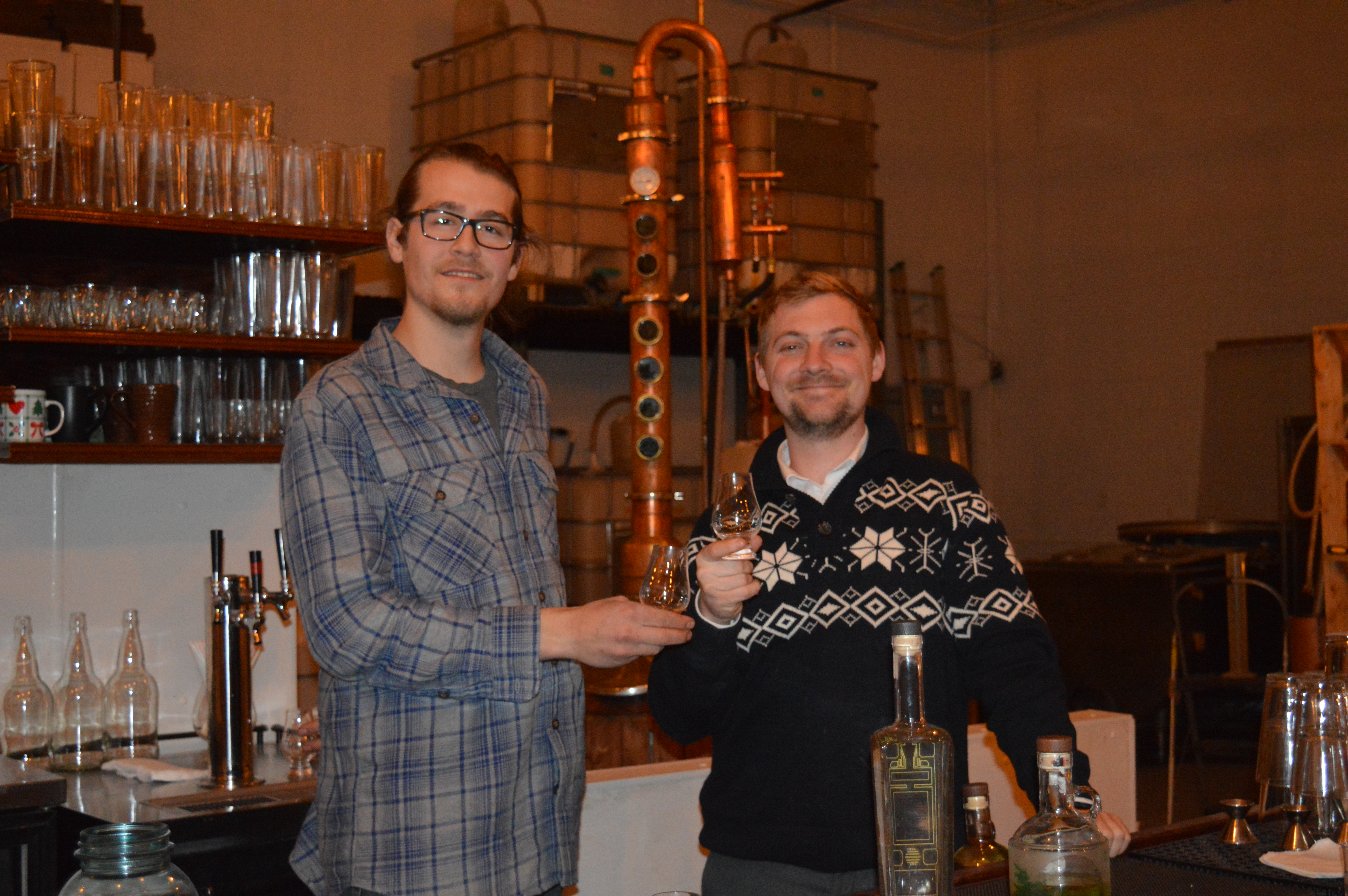
Simeon Rossi (left) and Mark Schiller (right) founders of Loon Liquors
For Simeon Rossi, it hasn’t, because he never left. In the midst of the commemorative White Russians and drunken farewells, Simeon and Northfield High School friend Mark Schiller discovered something better than Rossi’s Texas job could offer: alcohol. Just three days after the White Russian party came to a close, Mark realized that not only did he want more of Simeon’s self-concocted coffee liqueur, he wanted to share it with the public. The request for another taste of the enticing drink seduced Mark’s business side, prompting the question: “Who’s doing craft liquor in the state right now?” The answer was, quite simply, no one.
And with that, 5-10 gallons of coffee liqueur consumed and a 1,000 mile map-quest erased from the GPS, Simeon traded in the Tex-Mex and country accents of Texas for his quaint hometown of Northfield, MN, whose only claim to fame is the defeat of Jesse James and an air quality that alternates between smells of cookies from the Malt-O-Meal factory and turkey farms. As if it were something simply picked up while cleaning up after the White Russian Party, the two high school buddies turned to each other and said: “It sounds like we’re gonna start a distillery. Okay…let’s do it.”
On a frigid and silent night in the middle of the winter, strict adherence to Siri’s report of the Google map directions leads to a shadow of a building surrounded by the industrial lots of “McLane Company, Inc.” and a small lodging area aptly named “Old Warehouse”. As a business that relies on customers to drink the alcohol they create, Loon Liquor’s location is rather oxymoronic and the distillery is rarely found on the first try. But the isolation and quaintness were exactly what Simeon and Mark were searching for when starting Loon Liquors.
“Our satisfaction rate is higher in Northfield,” Simeon says about why they chose to settle down in Northfield, as opposed to the more populous Twin Cities.
“We get to meet all these townsfolk and the people that live around in the community. They get to know us; we shake their hands and get to know their names. And we get to bring them into our space and build community here, which is really lovely. So, in a lot of ways we are closer with our community because we’re in Northfield, as compared to, say, if we opened in Minneapolis or something. There may be more people who love our product there, but it’s less personal. We wanted that personal touch.”
Northfield’s small community also helped raise money for the duo’s kick-starter campaign. It turns out there are quite a few logistical differences between making alcohol for a going away blowout and providing drinks to an entire town, even one as small as Northfield.
“I went to talk to the state,” Mark said. “And the state was like, ‘yeah that’s gonna be $30,000 a year.’ Because we would just be mixing vodka, or rectifying it with coffee and sugar. But, if the Surly Bill passes, which it did, it would bring it from $30,000 to $1,100.”
The well-timed Surly Bill opened the heavy door of financing for Mark and Simeon. With an additional $11, 500 provided by over 100 members of the community in an Indie-Go-Go campaign, they leveraged enough money to become the first distillers in southern Minnesota to receive Federal permission to produce spirits in over 100 years. It’s almost impossible to imagine the 3.2 million people in the Twin Cities, a population 159 times larger than the measly 20,500 of Northfield, banding together to donate money for a business that doesn’t even exist yet. Growing up in Northfield gave Simeon and Mark a leg up from the outside distiller’s view. The intimate community of a small town with a skewed ratio of cows to people was the ideal reflection of the values that Mark and Simeon were looking for in their future distillery.
But despite the blessings of community support and opportune bills, how exactly does a guy who was destined for a job working with endangered species and his high school business friend start producing their own craft spirits?
According to Simeon, knowing Swedish can be a useful tool.
“I had to auto-translate a lot of Swedish to figure out how this Swedish gentlemen, who had a long history of making stills, was making mid-size stills. It just doesn’t happen much. So, on that end, the still-making involved lots of research, lots of reading, just lots of hodge-podgeing.”
Patience and innovativeness are also major keys to success in the distilling industry. Simeon and Mark, with help from some friends and family, have collected the materials and built the entire cocktail room and distilling equipment themselves. If there were a book called Antiquing: Distiller Edition, Simeon and Mark would be the authors.
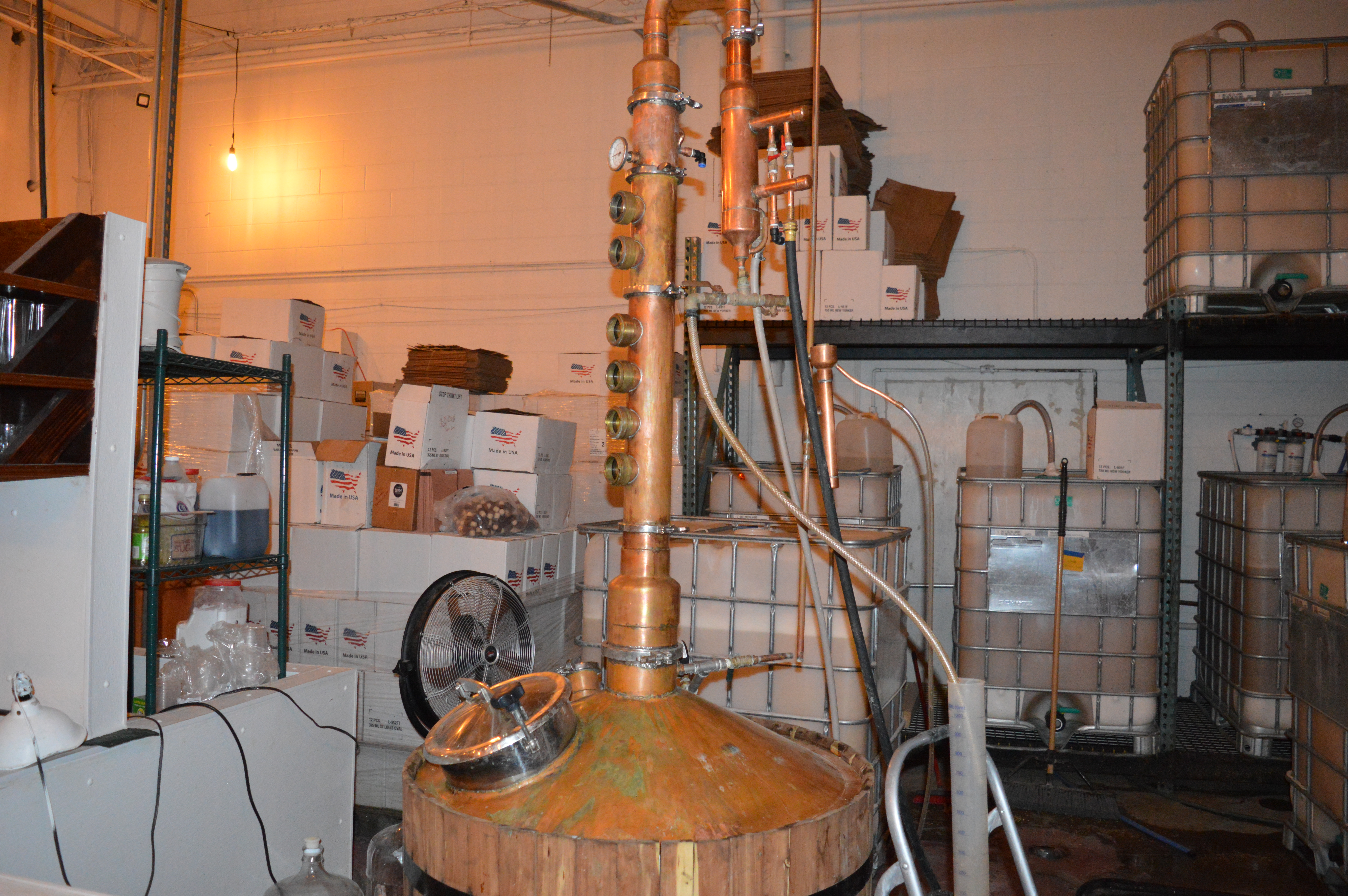
Loon Liquors’ tasting room is also their functioning distillery
“It’s all just hodge-podged together,” Simeon says. “Like that cylindrical tank was for wine storage and we had a big screen built for the bottom of it. And this is a repurposed milk tank!” Simeon giddily announces this fact as he points to part of the distilling equipment. “They said, ‘hey if you can get this out of our barn then you can take it!’ So we pulled it out and took it. Those types of things. Thrifty, but makes our product unique.”
The theme of mish-mashing ideas and products together is a common one at Loon Liquors. Realizing that people only enjoy coffee liqueur in the cold winter months, Simeon and Mark had to find a new product with year-round demand to present to the public. Simeon’s thought process on the product of choice reflects the duo’s necessity for individuality and humor.
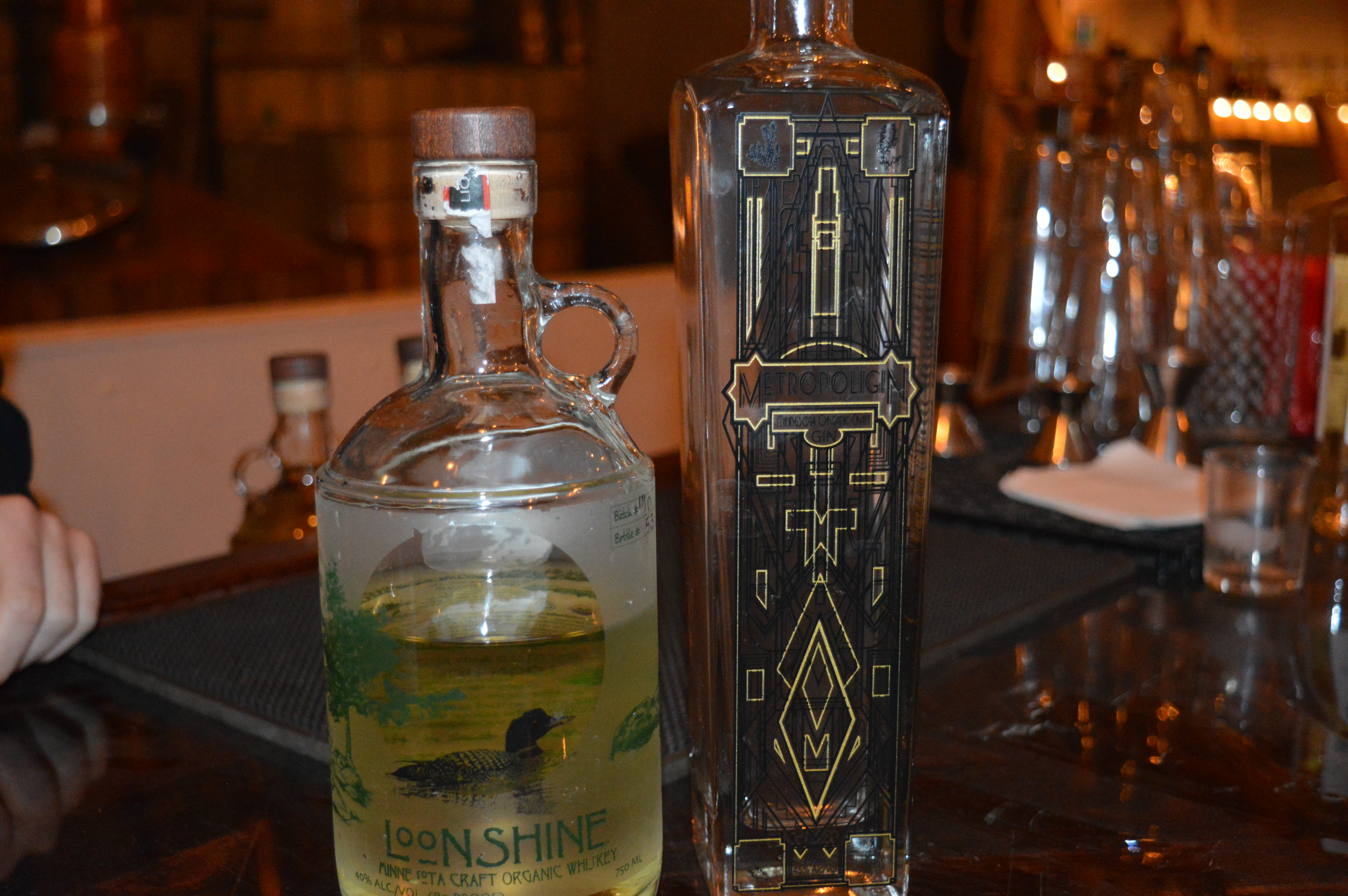
The craft distillery’s two products: Loonshine Whiskey and Metropoligin
“Vodka is colorless, scentless, ya know, tasteless. It’s just meant to not have any character. Why would you start a company and try to create something that would hopefully taste like nothing?” So Simeon and Mark decided to create some character and do an un-aged whiskey.
Mark and Simeon extended their desire for unique beverages even further, as Mark describes: “‘Let’s not do a corn whiskey because everybody does corn whiskey in the U.S. right? Let’s do a wheat and barley whiskey. Like an Irish style, smooth. It’s not peaty, it doesn’t punch you in the face. Let’s do closed fermentation.’” And out of all these requests for uniqueness, Loonshine ($35) was born.
Made from locally sourced organic barley and wheat, Simeon and Mark use closed fermentation to ferment their alcohol for three weeks. The standard for the distilling industry is 4-5 days, at most a week. Simeon, the expert drink mixer, firmly believes the added time creates a difference in taste.
“We find that the secondary and tertiary fermentation that’s happening over time, and the evolution that happens in a closed fermenter makes a smoother, more interesting product.”
Mark, the businessman of the pair, understands the value of providing a quality product to the public: “Let’s wait two more weeks and we can create a product that we really stand behind, versus ‘oh we created it really fast and we made a bunch of money, but no one wants to re-buy a bottle.’”
It isn’t just Simeon and Mark’s refined palette that tastes the difference; customers have noticed as well. In the cocktail room on a Friday night, a young man sipping on a Cedar Old Fashioned ($7) made with Loonshine compared the cocktail to “caramelized brown sugar bananas”.
The newest product, Metropologin, has also entered the spotlight at Loon Liquors and in Minnesota, being the first craft gin in the state. Made with undertones of citrus that can be seen in full force in the homemade ginger ale, a sip of it doesn’t leave you begging for tonic but instead stands on its own as a sweet, yet sophisticated spirit.
Customers at Loon Liquors are invited into the ongoing evolution of the party that initiated the entire business. Simeon and Mark treat people who come into their cocktail room as members of their team, a collaborative partner along their journey.
“They help, in a way, guide us,” Simeon says. “Whether that’s new ideas for cocktails or new ideas for products. It’s the same as in college, like ‘oh man, is this coffee liqueur better?’ I mean, right here is where we have our testing ground for new products.”
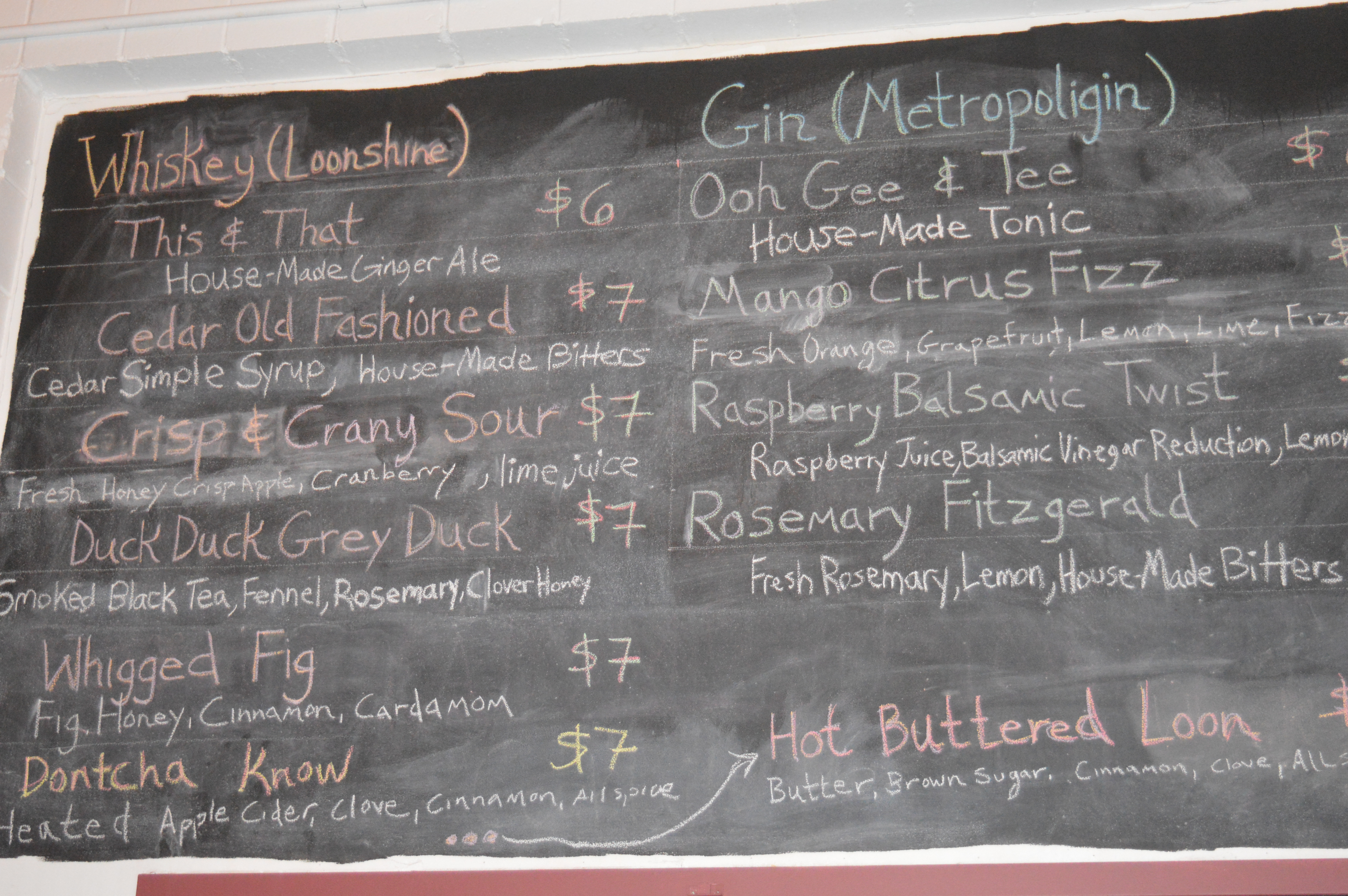
An example of Loon Liquor’s ever changing cocktail menu
And testing ground is the appropriate word for Simeon’s concoctions. Glancing at the drink menu, written in colorful chalk above the entrance of the door, leaves you dazzled by the multiple different abstract cocktails staring back at you. From the Whigged Fig ($7), a Loonshine cocktail mixed with figs, honey, cinnamon, and cardamom, to the recently added My Aching Heart ($7) to honor Valentine’s Day, the cocktails are original products pulled straight from the artistic mind of Simeon.
The eccentric nature of each cocktail produced suggests that if you were to walk behind the bar, you’d find Simeon pulling a slot machine lever that spits out abstract ingredients to put into drink form. In fact, Simeon uses his youthful passion for brewing beer and coffee liqueur to ingeniously create incomparable drinks.
“For the Whigged Fig, I was thinking of winter things and I thought of figgy pudding. And I was like, ‘What even is figgy pudding?’ So I started tasting and eating figs. Thinking about figs. And then I thought, ‘What goes well with this?’ Cinammon spice. Our whiskey.”
For the Crisp and Cranny Sour ($7), Simeon found himself reading a New York Times article one day that was bashing the honey crisp apple. So he created a cocktail to give the honey crisp apple a chance to speak for itself.
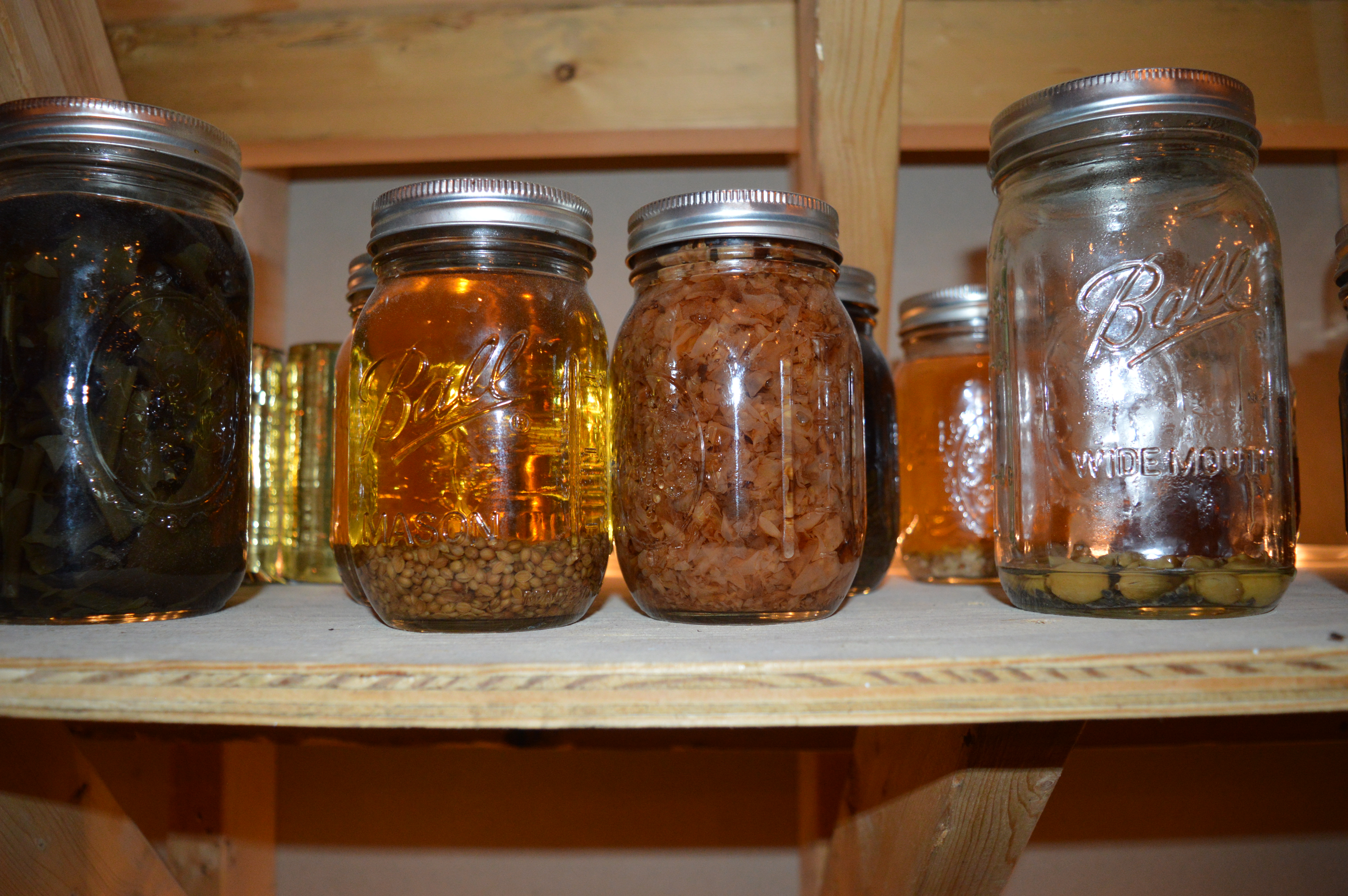
Some of Mark and Simeon’s experimental infusions
“That cocktail was me saying, ‘Uh shut up bro! You know what New York Times, you don’t know what you’re talking about.’ So I took honey crisp apples and put them in the spotlight.”
A close investigation of the shelves in between the cocktail room and the distilling equipment gives you a glimpse into the mind of Simeon Rossi and an explanation for where some of the most abstract cocktails come from. Lined up across three shelves are dozens of mason jars filled with what look like the various stages of an alien life form. Some contain pickled fruits marinating, while others are filled with olives and anchovies brewing in their own salty bath. Truth be told, there could be anything in those jars and Simeon would produce the next best-selling cocktail out of it.
These concoctions are just part of the story of Loon Liquor’s quirky and unique persona. Simeon and Mark are adamant about providing their craft spirits in an organic, local, and environmentally sustainable way. The wheat and barley that is used in both the Loonshine and Metropologin is grown within 10 miles of the distillery.
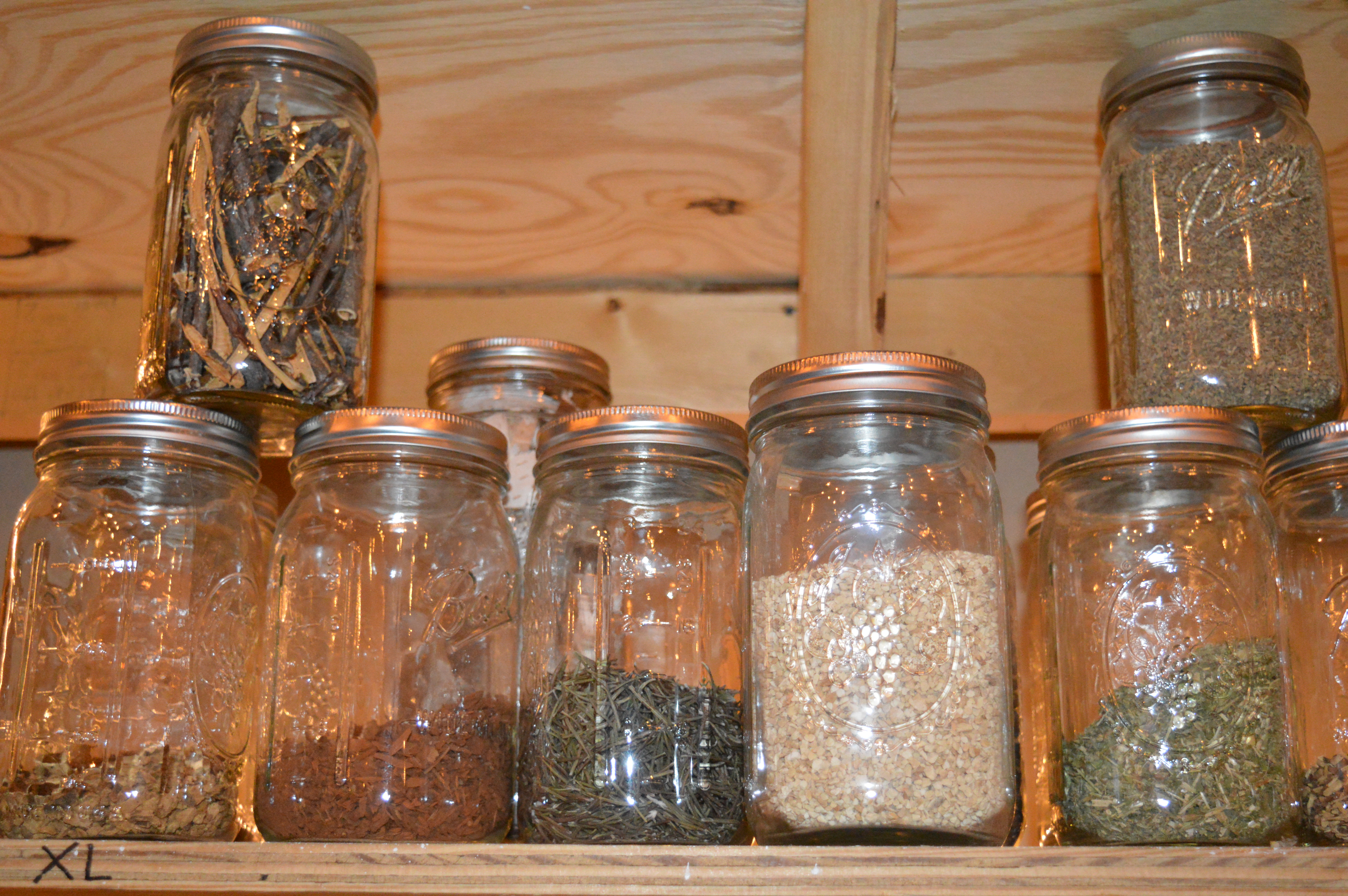
Herbs and spices for custom liquor infusions
“We do everything,” Mark says. “From creating and grinding the grain, to putting it in the mash ton. A lot of distillers, whether you’re seeing it or not, will buy their spirit from Indiana and bring it here. Not having any of this equipment, they’ll just have the still. They run it through the still once and say it’s made in Minnesota. However you feel about that is how you feel about that. What we’re doing is completely from grain to glass. A lot of hard labor.”
And that hard labor has paid off. Not even a year after opening the cocktail room, Loon Liquors is already evolving and growing bigger. Simeon and Mark are aware of the place they hold in the distilling industry and what it means for their future. Their goals are lofty, and involve following in the path of the craft breweries, which Mark likens to their big brother in the industry.
“If you look at what craft breweries have created for us, it’s an appreciation for one’s palette.”
Simeon and Mark hope to create the same appreciation for craft spirits, and they’ve already seen significant growth in the spirit industry. In the past four years, high-end spirit has seen a growth of 7%. Bourbon specifically, has been sold in 20 million 9-liter cases in the United States alone in the past year, representing nearly $2.9 billion in revenue for distillers. These statistics provide Mark and Simeon with some much-needed confidence when looking into the future of their business.
As for where Simeon and Mark plan to take the party next?
“Simeon and I have some visions for how to evolve,” Mark says. “Obviously, we’re in a 2, 100 square foot space, of an industrial area. And we’re part of a larger complex. So really at the end of it this is an incubator. So think of this space, think of the cocktails, think of what we’re generating right here. It’s our base products, our base spirits, base cocktails. Then from there we develop our recipes.”
In terms of what those recipes are, Simeon and Mark have a vision for a destination distillery-botanical garden combo.
“That’s super fucking cool, ya know? Especially if we could do botanicals, with the gin.” Simeon compares his vision for a botanical distillery to a winery: “When have you really liked to go walk around a bunch of grapevines? It’s cool I guess, like wow look at that grape! But it’s boring! It’s like walking around a cornfield. But what if you were walking around a botanical garden? That’s pretty dope.”
The call to return to Mother Nature’s natural elements has always been present for Simeon and Mark. Despite Simeon’s decision to pursue distilling instead of his job with endangered species in Texas, Loon Liquors has maintained an intimate connection with the land. The name for Loon Liquors arose from a 45-year tradition in Mark’s family of canoeing around the Boundary Waters and Canada.
Simeon describes the interaction with nature that inspired the distillery’s name: “You’re out on the water, no one else but you and your partner in the canoe. Maybe a couple other boats you’re with. And Loons are big!! They pop out of nowhere and there you are. It’s a really strong connection with this other creature out on the water with you.”
The other expansion option for Simeon and Mark is to move to Division Street, the main strip of Northfield’s “downtown”. The complete opposite of a destination distillery, the appeal of Division’s visibility also brings with it the hordes of college students on Friday and Saturday nights. The benefit of increased popularity could also come at the cost of Loon Liquor’s speakeasy feel.
“Maybe it’s cool that we’re just that little cave out of town,” Mark says. “That you have to go down by the crick a little bit to find.”
Reminiscent of the theme of the party that initiated the whole business, Loon Liquor’s atmosphere calls for the customer to pause their daily lives and sit down and enjoy quality time with friends. The target market isn’t a bunch of rowdy, newly-turned 21-year-olds looking for their first experience with alcohol.
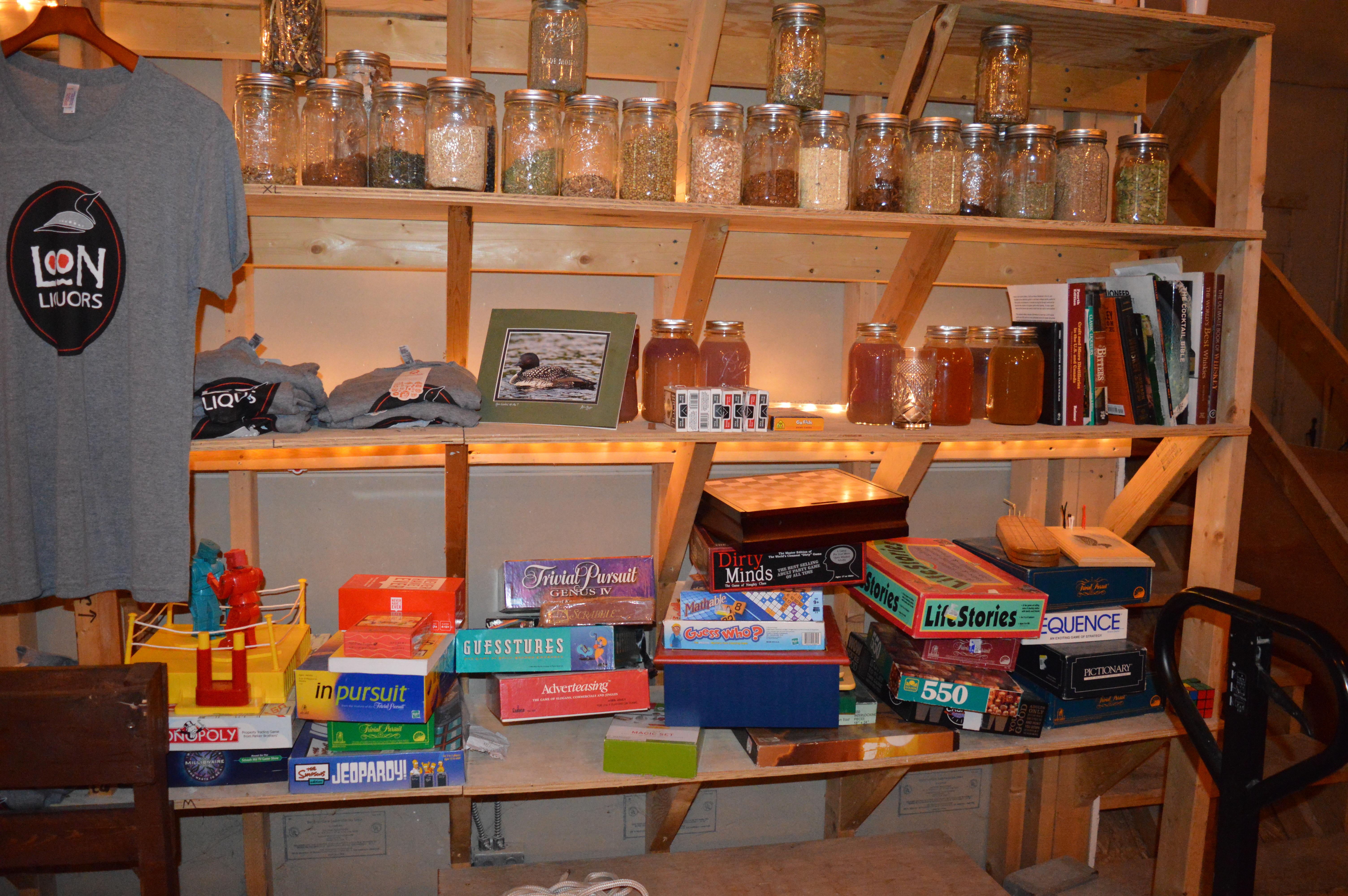
The cocktail room comes with an impressive board game selection
A Friday night spent in the cocktail room can be tailored to whatever your interests are. If you want to share cocktails with your friends after a hard day of work, the large wooden tables and benches that are made of reused grain shipping pallets allow for groups to sit together and share their drinks. If you’re interested in a quiet night enjoying some board games with a close friend and listening to great music, Loon Liquors has two shelves stocked full of games and puzzles, including the newly acquired Rock ‘Em Sock ‘Em Robots. Simeon and Mark are planning a tournament for their customers where they can enter and play against other competitors in a robotic showdown. They have the referee costume ready and waiting.
When you walk into Loon Liquors, you find an appreciation for liquor and an appreciation for the finer things, without being snooty as hell. And that’s a fine balance. Most importantly, you find a comfortable place to enjoy a drink, whatever that means to you.
“It’s all about this tribal knowledge,” Mark says, “Now you have the knowledge that you’ve visited the only distillery in Southern Minnesota and probably the only distillery for 40 or 50 miles. Well, legal distillery. But you get to take that knowledge back now. And you can say ‘I know a place in town that offers 6, 7 dollar cocktails that they make completely from scratch.’”
Loon Liquors has some lofty goals, but right now they are content to remain in the comfort of their friends who visit every week and get to see the evolution of the place.
“This is where we’re at right now” Mark says, “Like it or love it or leave it, whatever. This is where we are. But you come back in a couple of months and we’ve got vodka. It’s always a little bit different. It’s evolving every time you come in.”
Simeon and Mark expect that when you walk in the door, they’ll see you again. It all began with a going away party and some quality alcohol. Six years later and Simeon and Mark are still brewing creative and superior spirits for their friends. Except now the tribal knowledge of the White Russian Party and the coffee liqueur that started it all has traveled to the community of Northfield.
Loon Liquors is located at 1325 Armstrong Road, Suite 165 in Northfield, Minnesota. The cocktail room is open Thursday-Friday from 4:00pm until 12:00am, and on Saturday from 2:00pm until 12:00am. Cocktails range from $6-8 and non-alcoholic sodas, including a homemade ginger ale, are also offered. Additionally, Loon Liquors offers a few food items, including a meat and cheese plate. Patrons are also allowed to bring food into the cocktail room at any time if they want.


Recent Comments