Picture yourself in a typical college dorm room on a Saturday night. Three young men sit hunched around a laptop, refreshing the browser. There’s an electronic BING and the mail icon lights up. The subject line of the message reads “re: ISO Huana – FT Darkness.” To the uninitiated this may read as gibberish. It’s the kind of email that would at best register as spam and at worst come off as a malicious attempt to hack into your computer. To members of the r/beertrade community this email is pure joy distilled into pixels. The three guys jumped up and celebrated like a team that had just won a championship game. The chant of the night was, “We got the Huana!”
Over the past decade, the craft beer scene has grown exponentially across the country. According to Forbes, since 2008 the number of craft breweries has more than doubled. Over this same time, the number of barrels of craft beer produced has risen from nine million a year to over twenty-two million. Currently, on average 1.9 craft breweries open each day. In 2015, NPR ran a story chronicling new microbreweries’ struggle to find beer names that have not yet been trademarked. The craft beer world is not a hegemonic entity in the national mindset, as like many American subcultures, views on the subject vary. For some people the story of craft beer is played out and uninteresting, and others could not care less about fancy beer, as highlighted by a heavy handed Super Bowl campaign produced by Budweiser last year, mocking the craft beer scene.
Inside this niche of American culture, lies an even smaller niche, people who trade craft beers on Reddit. Several of the top rated craft breweries in the country have limited distribution. Take for example the seemingly nonsense names in the email to the three college kids. Huanahpu’s (Huana for short) and the Darkness are two premium imperial stouts, the former from Cigar City Brewery in Miami and latter from Surly’s in the Twin Cities area. Both Cigar City and Surly’s have limited distribution, meaning that if you live in Florida you won’t be able to get your hands on Surly’s and if you reside in Minnesota, Cigar City brews are out of reach. In order to circumvent these geographic limitations, craft beer aficionados have taken to the Internet.
If you’re still with me at this point, you are probably wondering how you go about making a trade on Reddit and why those three young men from the beginning were so excited over that email. I sat down with four prolific beer traders to work through the ins and out of the trading world. The traders I spoke with were all males aged 21-35, living in Minnesota. The person who tipped me off to the scene is Gar Crowell, a senior economics major at Carleton College (and also my roommate.) When I started bothering him with questions, he pointed me to his two guru’s, recent graduates of Carleton College, Andy May and Nolan Baker. Andy and Nolan have both been trading for three years, and regularly make pilgrimages to regional breweries, arriving as early as four in the morning, in an to attempt to score a limited release brew.
After talking with these two, and sharing a few unique beers (habaneros do not make for a refreshing aftertaste), I asked them who they thought could do the beer trading scene justice. On their recommendation, I reached out to Mrpeterandthepuffers (this is his Reddit user name, he asked not to have his given name included), the colorful thirty-something who splits his free time shuttling his son to hockey games and accumulating beers in his massive cellar underneath his suburban Apple Valley home. Mr. Peter, who originally traded cigars online, has been swapping beers on Reddit for the better part of a decade.
The first step in becoming a beer trader is getting acquainted with your local beer scene. Say you live in Minnesota; you’re going to want to start stocking up on Surly’s and Fulton’s, especially the limited releases. Other craft breweries, like Summit, might make just as good a beer, but they distribute across the country, which greatly diminishes their value on the trade market. Next, you have to find out what beers you’re looking for. This gets into a more personal part of the process.
Some traders, like Andy May (or mayxday as he is known on Reddit), trade for a variety of different types of beer, with an eye towards expanding their palates. Other traders, like Nolan Baker (nb114 on Reddit), treat the beer as a commodity. Valuing the beer based on its relative scarcity, this line of traders behaves like Jordan Belfort on Wall Street, attempting to negotiate deals and come out with the more desirable beer. The veteran trader of the bunch, Mr. Peter, has a more simplified strategy. As he put it, “I try to trade for beers that I want to drink.” These are numerous points along the trading spectrum, as everyone that I talked to claimed people change their strategies from trade to trade. Once you find a beer worth trading in your area and have your heart set on a beer out of your reach, it is time to hit the message boards.
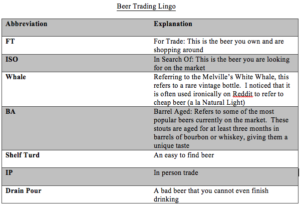
The hyper specific vocabulary of beer trading becomes readily apparent when you log on to r/beertrades. Luckily I have compiled a beer trading Rosetta Stone for first timers. Traders scroll up and down the message board looking for a user that is in search of one of their beers. This is where a beer’s value comes into play. From conversations with beer traders, it seems that three factors determine value: price, rarity and ranking. Take for example Surly’s special release, the Darkness, described on their website as a “massive Russian Imperial Stout which brings waves of flavors; chocolate, cherries, raisins, coffee, and toffee, finishing with a non-traditional dose of aroma hops.” This beer costs $20 per bottle, is only released once a year, and is ranked highly on all well respected beer forums. The Darkness is an ace on the open market. Once you find a trader who has a beer you’re interested in, send them a message and start working out the details of the trade.
In an unregulated industry, like black market beer trading, individual reputation is the most important trait. After each trade completed on Reddit, both participants provide feedback on their counterpart’s profile page. There is a forum administrator that manages a list of users that receive consistent negative feedback and ban them from the page. Apart from the administrator, there is fairly little oversight on the forum, which means if you trade with a scammer, you have no way to get your beer or money back.
Additionally, the legality of mailing beer is a gray area. Not every state permits shipments of alcohol to residents. There are several interesting quirks in states liquor laws, but if you live in PA, TX, MA, UT, MD, DE, AR, OK, MT, ME, SD, KY, AK, HI, WV or MS you can’t have alcohol of any kind delivered to you. Even if your trade is 100% legal and a scammer swindles you, several traders have made it clear that turning to the authorities is not a good option. Mr. Peter put it bluntly, saying “you won’t get help from the police over a $20 bottle of beer.” Luckily, it’s a small enough world that horror stories are few and far between. Mr. Peter only recalled one example of a friend getting cheated out a promised beer. He was quick to point out that the guilty trader had a shady reputation, and he would have never traded with him in the first place. Traders without stellar reputations are scrutinized and often avoided.
Now comes the hard part. Once you’ve negotiated the terms of your agreement and navigated through any moral qualms you might have operating in a legal gray zone, it is time to ship your beer. For larger bottles of beer, Styrofoam wine holders work well. If you cannot get your hands on a foam holder, carefully packaged bubble wrap and newspaper can work just as well. One of the easiest ways to damage a reputation score on the forums is by failing to adequately protect your beer. Andy May says he can spend up to a half hour creating a comfortable home for his beers. “I like to really make sure the beer won’t break en route. I’ve had one beer break, and luckily the guy gave me the benefit of a doubt. It is definitely hard to find people to trade with if word gets around that you’re a poor shipper.”
Apart from the nerve-racking elements of mailing bottles of glass filled with liquid gold, another deterrent to the trade is price. Beer traders are already paying a premium price for craft beer, and shipping and handling can be expensive. The traders I spoke with reported regularly paying the same for shipping as the original cost of the beer. As hobbies go, you can definitely find a cheaper one than beer trading. In the trade earlier, our three heroes ended up paying nearly $50 for a single 28-ounce beer. If you have some disposable income to play with and have been able to follow the process through the various hoops, take your packed beer down to your local post office, ship it off, sit and wait to reap the fruits of your toils.
While the beer traders I spoke with provided diverse perspectives and insights into the beer-trading world, there is one thing they all agreed on, the beer is worth it. All the stress that accumulates in the initial stages of the trading process dissipates instantly when your package arrives. Nolan Baker, who received a rare barrel-aged stout in the mail just a week ago, talked about opening the box with the same enthusiasm you would see from a six year old on Christmas morning.
There is a significant social scene that has developed around beer trading. None of the traders I spoke to liked to drink on their own. Mr. Peter described various beer clubs that he is a part of around the Twin Cities: “Most people don’t just drink their beer alone,” he said. “I have a few different groups that I drink with. One group is in my town, neighbors and stuff like that where everyone has kind of been sucked in more and more to craft beer by each other and we get together most Thursdays and sometimes on the weekends.” Beer trading brings people together.
The other traders I spoke to shared stories similar to Mr. Peter’s, describing fairly extensive social networks that have developed both online and in person due to beer trading. Andy and Nolan described a recent show and tell experience they had with fellow traders. A group of ten traders scheduled a meet up, and each brought a beer that they wanted to show off and share. Andy said, it was fun to meet new people, but it was more fun to try some beers I had never heard off.” It is a niche inside of a niche, but for the people who have the means and desire, beer trading is a great way to try new beers, meet new people and pass the time. As the craft beer market continues to grow at an exponential pace, there are uncertainties that loom large in the minds of beer traders.
During my discussions with the various traders, I noticed they highlighted three main concerns. The first two were centered on the continued growth of the craft beer scene and trading world. Traders are worried that increased popularity might draw attention from regulators. Right now the low volume of trades does not draw scrutiny, but if trading continues to grow, state liquor authorities might feel the need to step in and regulate the practice. The Minnesota Department of Alcohol and Gambling require licenses for wholesale alcoholic transactions, but they did not seem to mind the small level bartering taking place in the cloud.
Another fear stems out of the increased distribution that comes with growth. Some traders are worried that as microbreweries grow larger and larger, they will expand their distribution. Take for example Ballast Point; a microbrewery that was purchased for $1 billion last summer by AmBev. Prior to the buyout, you could find a number of Ballast Point products sporadically across the country. In the six months since the buyout, consumers can find a consistent selection of Ballast Point beers in local liquor stores from New York to Seattle. While the increased distribution makes beer more accessible to the general public, Nolan Baker worries that it will take some of the excitement out of beer trading. For the moment, several microbreweries like being local. A representative from Surly’s made it clear that the brewery is focused on bringing great beer to the Minnesota area. While he didn’t seem to mind people trading their beer he said, “the best way to get your hands on Surly’s is to make the trek out to Brooklyn Park.”
Lastly, the beer traders all shared a fear that is fairly prevalent among craft beer connoisseurs. The growth rate of the craft beer market does not seem sustainable, as reputable news outlets, including the New York Times, Fortune and Vice, have referred to it as a bubble. Andy May shudders at the thought of the bubble popping. “There are so many options on the market right now, if this “bubble” popped, it would be tough to go back to just drinking normal beer.” Brewers and consumers are fairly adamant on various online forums that we have yet to hit peak craft beer, so the fear of returning to Bud and Miller Light is somewhat premature.
In order to see if all the fuss over the beer was worth it, I joined the three men from the beginning to crack open the Huana. The first couple of minutes were dominated by comparisons of tasting notes and overacted sniffing. As the pretense died down, the strongly alcoholic beer worked its way into the bloodstream and the evening devolved. It was just a couple of friends sharing a beer, with a few added steps.




Recent Comments