A Portrait of Farm Life in Rice County, MN
By Serena Bernthal-Jones

A threshing crew on the Swartwoudt farm in 1910.
They are gathered outside the old family farmhouse – the Swartwoudt farmhouse in Dundas, Rice County, Minnesota. Four Swartwoudt women, two mother-daughter pairs, stand shoulder to shoulder. A dozen or so men take up the rest of the frame, dressed in overalls and work boots. Two of the younger ones hold a third on their shoulders, asserting their youth and physical strength. Front and center stands a well-dressed man, clad in a button down cardigan and dress shoes – certainly not suitable for work in the field. He stands upright, hands clasped behind his back and chest puffed out.
The central player in this scene, however, goes almost unnoticed. Standing in the very back, face barely visible behind three taller men, is John M. Jones. He is the owner of the steam-powered threshing machine, the reason that this group has come together. He is also my great-great grandfather.
This group, a threshing crew, was comprised of neighborhood men, women, and teenage boys. “Threshing” the oats, barley, and wheat involved separating the seed from the straw, a task accomplished in the early days by spreading the grain on the floor and trampling it by foot. The invention of the steam-powered thresher in the late 1800s made the job easier, yet one that still required about a dozen men. This sharing of labor became a tradition born out of necessity.
During the months of July and August, the grain was cut, bundled and stacked into shocks to dry. The threshing crew would then come through, following the machine from farm to farm to help with the final step of the harvest. The shocks were loaded onto horse-drawn wagons and brought to the thresher, and then fed into the machine. A threshing crew was typically made up of men and boys from half a dozen farms, most of which were small, around 80 acres.
The women of the hosting farm had an equally challenging job: to feed these hungry men. Noontime meals were built around heaping quantities of mashed potatoes, meat loaf, and baloney. If families were doing well financially, there might even be roast beef. And then there were the pies: often sliced into four pieces, rather than the standard six. Without refrigerators, having leftovers was out of the question.
Growing up in Seattle, I loved hearing my grandfather tell stories of life on the Minnesota farm. The world of the threshing crew – of neighbors coming together over work and a meal – was both foreign and intriguing. For my grandfather, it was his life. For me, it was a story of another era.
Over the years, individual farms got larger while the number of farms got smaller. According to the USDA Census of Agriculture, there were 2,380 farms in Rice County in 1910, averaging 125.2 acres. By 2012, the number of farms had dropped to 1,304, while the average farm size had risen to 181 acres. Technology also changed. The 1930’s brought about the introduction of the combine, a self-propelled machine capable of both cutting and threshing. Gone was the steam-powered threshing machine, and with it, the need for a threshing crew.
One hundred and three years after the photo was taken, I found myself attending college just 3½ miles from the very spot the photo was shot. Suddenly, this past was not all that distant.
Equipped with a detailed Google Map, I set off to find the site of the old family farm. Half a mile out of Dundas, I came to a gravel driveway bordered by a stand of poplar trees. Surveying the land, my eyes came to rest on the remnants of the well casing, marking the spot where the farmhouse once stood. I stood staring off at the frozen plot of rolling farmland, trying to place the many stories I had heard.
What has become of these farming communities without the threshing machine to bring them together? Has the tradition of neighbor helping neighbor survived the introduction of the combine and the lurch into modernity? Certainly, a lot has changed, but I was equally curious about what has stayed the same. Equipped with an image in my head of a time gone by, I set out to find what that present looked like.
Filling in the gaps proved to be a bit harder than I initially anticipated. The family farm was sold on August 26, 1948, erasing all familial ties to Rice County. Putting Midwestern hospitality to the test, I began cold calling farmers in the area.
Elizabeth O’Sullivan from Auntie Annie’s Fields, a small, chemical-free egg farm located on the outskirts of Dundas, was among the first to respond. “I’ll see what I can do – but my time is awfully tight,” she wrote. “Want to come over while I wash eggs?”
The following afternoon, I sped past frozen cornfields and grain silos until the sign marking the city limits came into view: Dundas, population 1,367. After a few more miles, I spotted the house she had described over the phone: green with white trim. I turned into the unmarked gravel drive.
Sure enough, Elizabeth was in the kitchen surrounded by a fortress of eggs. White eggs, brown eggs, even green ones, covered every inch of available counter space. Brown crates were stacked precariously next to the far wall, threatening to be disrupted by her rambunctious five-year-old.
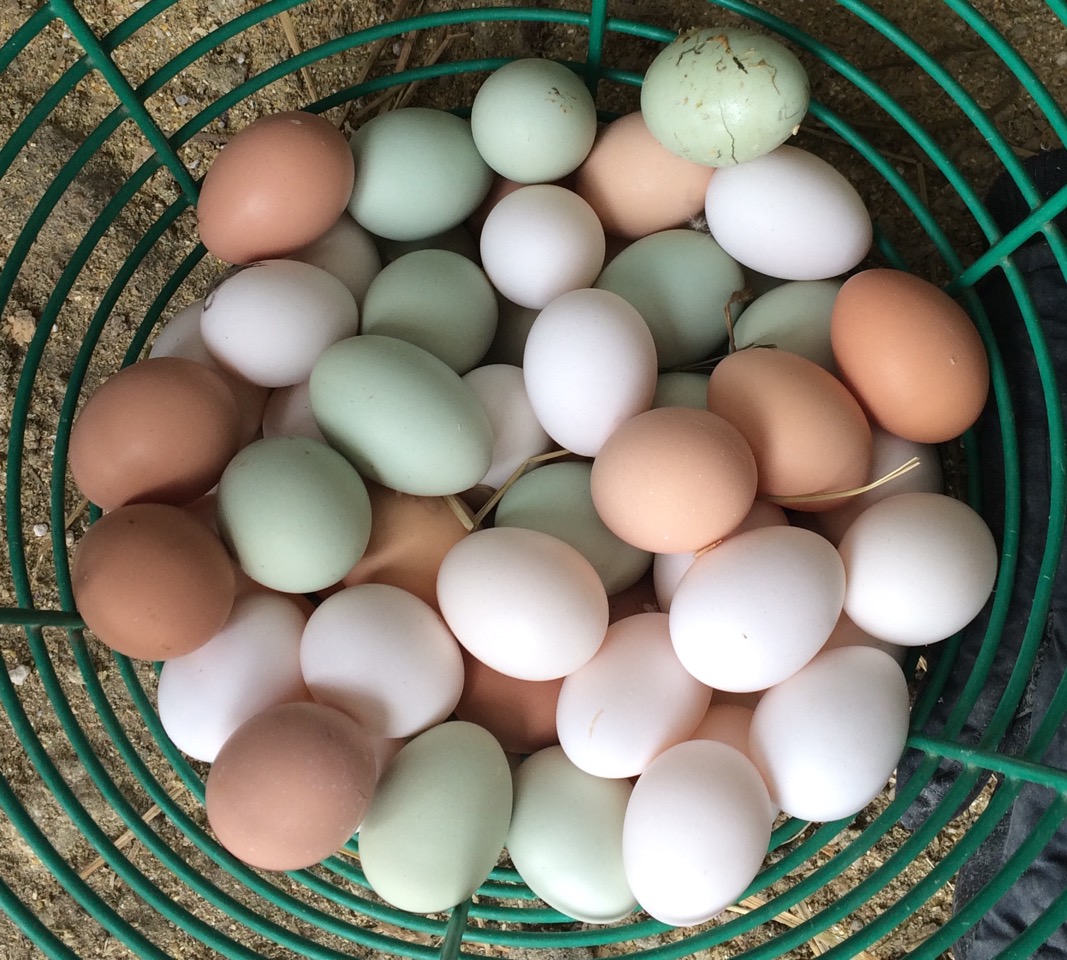
Eggs being washed from Auntie Annie’s farm
“It’s all just very practical. It’s not as idyllic as I once thought.” Elizabeth stands at the sink with her back to me, rinsing egg after egg in a tub of warm water. Asher, her youngest son, latches onto her leg as she tries to cross the room. She gives up, turning back to the sink. “Before, I would be like ‘Oh, to eat the eggs that I have nurtured and gathered. It would be so beautiful.’ Now I’m just like ‘Okay lets crack these up and get dinner on the table.’”
Elizabeth did not grow up on a farm. Neither did her husband, Ian, although they both had some farm work experience during their teenage years – Elizabeth on a dairy farm, Ian on a vegetable farm. “We had a few chickens,” she recalls of her childhood. After college, they worked together on a vegetable and livestock farm in the northern part of the state before settling into life on the edge of Minneapolis – Elizabeth as a writer, Ian as a 7th grade teacher. “We had a good life there. But every day I was carrying the weight of not having a farm.”
In 2007, they uprooted their lives and moved to a 20-acre plot about 6½ miles from the center of Dundas. “An office job was too hard on me; I had to go become a farmer,” she tells me, only half joking. They named the place after Elizabeth’s great aunt Anne, who had farmed in the northwestern part of the state. They now have three children and over 700 laying chickens producing about 30 dozen eggs a day. In addition to their duties on the farm, Ian continues to teach middle school in St. Paul while Elizabeth leads fitness classes at the Northfield Senior Center.
Despite her position as a newcomer, she is no stranger to the world my grandfather told me about. She too grew up hearing stories about the good ol’ days of Auntie Annie, of the threshing crews, of neighbors helping neighbors, and of the big hearty farm meals. “Because of the mechanization, stuff is less communal now,” she admits.
In the beginning, Auntie Annie’s Fields was part of Community Supported Agriculture [CSA], selling their eggs and chickens to people in the surrounding area and in the Twin Cities. “The CSA model really gives you a good relationship with people that you don’t get just selling at the markets. Since we stopped doing the [the CSA], people stopped coming.” Now, it is just their old friends from the Twin Cities who come to help out when they need some extra hands. “They feel bad for us”, she says laughing.
When the washing is finished up, we head out for the second collection of the day. We trudge through the week-old snow, coming upon two chicken coops on the edge of the property. Raised off the ground by several inches and covered in white tarps, the coops look like covered wagons gearing up for a journey.
Elizabeth, standing 5 feet 11 inches, ducks to get through the door. Her jean dress extends past her knees, adding an extra barrier of warmth over her wool leggings. As she spreads the bedding across the floor, she tells of the many hands that went into building this new chicken coop last fall. This help didn’t come from the neighboring farmers, though; rather, a few of their old friends drove down from the Cities to help out for the day.
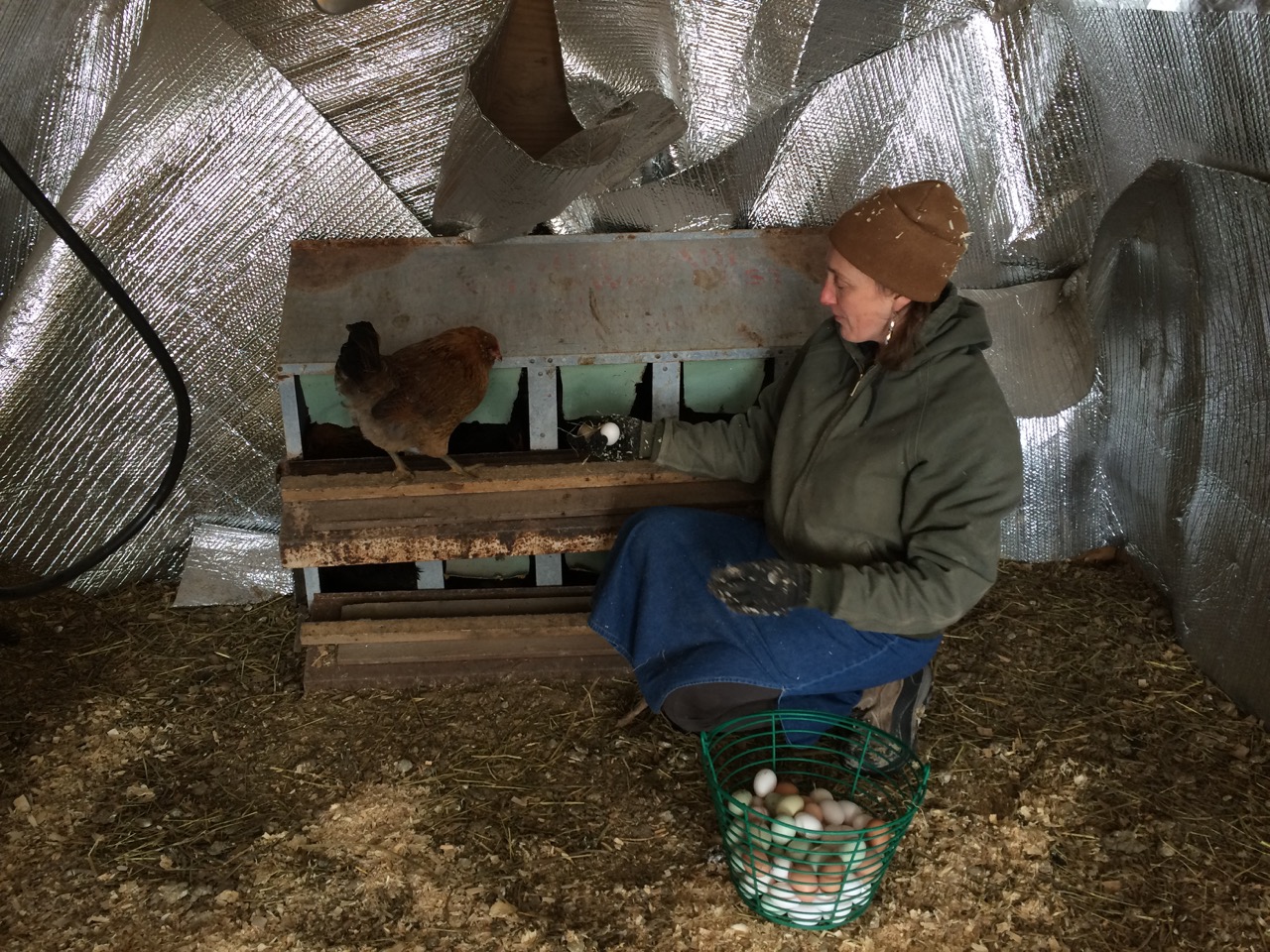
Elizabeth from Auntie Anne’s farm kneels to collect eggs
When labor is given, food must follow. Elizabeth recalls the stress of preparing a meal for the eight or so friends who were there. “It’s a little tricky in that it is a busy day. I remember feeling torn, like this 1950s housewife, like ‘you guys all go use your drills and I’ll go cook us up some nice soup.’ I felt kind of weird about I, like am I doing the right thing putting all this energy into making a meal?”
As she talks, she appears to continually surprise herself. While she tells me that communal labor like that of the threshing crew was a thing of the past, the life she describes is still one that is built around community– albeit unconventional and untraditional.
She is interrupted by a commotion of feathers and agitated clucking on the far end of the chicken coop. After a few seconds, the chickens settle back down. “One of the oldest food traditions we are a part of is trying to find ways of using what we have a lot of all the time without getting super sick of it.” Elizabeth is crouched next to a group of nesting chickens. “This kind of thing that I’m doing right now is super old school.” She delicately slides her hand underneath, producing an egg with ease to add to her basket without disrupting the disgruntled looking hen. It peers back at me, an intruder. “This is what my great aunt would do. This is what she did do.”
Nevertheless, being new to the community has its inherent challenges. “The people who have been here for generations are part of a different social group. Some of the longer, more old-fashioned traditions aren’t ones we are integrated with.”
We head back to the house, Elizabeth continues: “You talk to these people, and they know everybody. The connections, like my son dated his cousin. All these interconnections that we just don’t have. We are like this little cameo in an ongoing movie and we are not the main character. We are the main characters for us. But you can tell that there is this whole ongoing story and it is going to keep going on when you are gone, with people you are never going to know but they will know each other.”
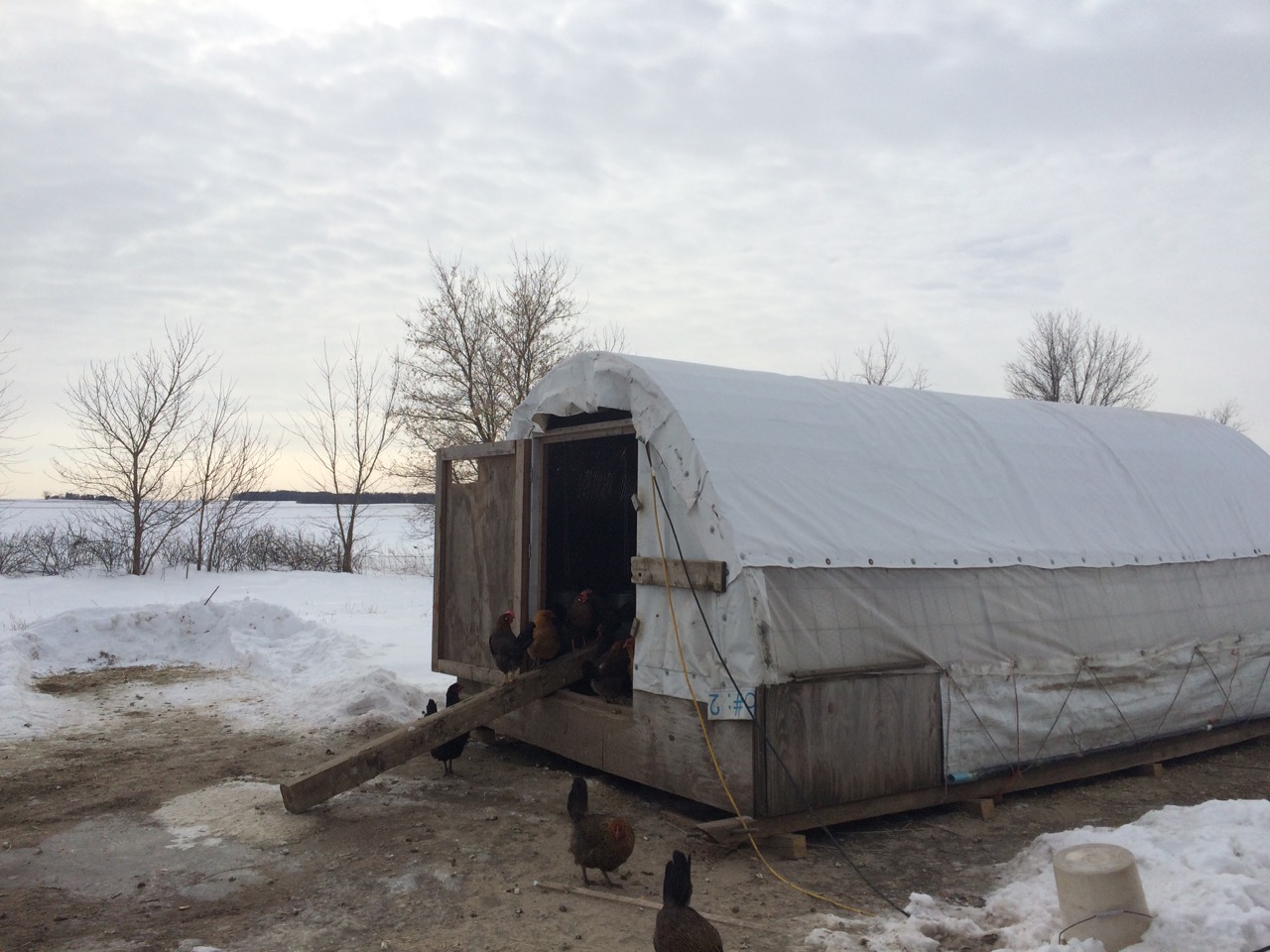
The new chicken coop constructed in December of 2015
Over the next few weeks, I tried to find an in into the community Elizabeth described. Sure enough, a woman I worked with knew some people, who knew some other people, and before long I was on the phone with Wayne Peterson, a fourth generation beef and dairy farmer. He and his wife, Nancy, currently farm land about eight miles west of Northfield on Highway 19. Their children are grown and have moved away from the farm.
Perched on the top of the hill, their red farmhouse overlooks 500 acres, land that has been in the family since the time of Wayne’s great-grandfather. Wayne greets me at the door, welcoming me into their spacious home. Nancy stands by the stove, stirring the chicken rice soup. Sunlight filters in through the bay windows, framing the long wooden table set for three.
Wayne’s great-grandfather came from Denmark at the turn of the century, purchasing the land and starting a life as a Midwestern farmer. Wayne took over the farm in 1969 when his father died. He was only 19. Back then, they ran a large dairy. Now, the farm is smaller, producing mostly beef.
Nancy spent her early childhood in Eden Prairie before her father, an electrical engineer, decided to try his hand at commercial egg production in Northfield. “I wanted to marry a farmer. And I knew absolutely nothing about dairying. But that’s the only way a dairy farmer can get a wife – to get someone who doesn’t know anything about it.”
In 1988, they sold their dairy cows. Soon after, Nancy took a job working in administration at St. Olaf to make up for the lost income. “I think one thing that has had a big impact on neighbor interaction is just how many farm women work off the farm now,” she says. “When we were first married, back in ’73, most of the wives around here were here on the farm the whole time. Just in the last forty some years that we have been married, there are very few that are not working off the farm now. And that has had a really big impact on the social fabric of the neighborhood because it’s usually the women that are the driving force in the social continuity. People are friendly, it just that nobody is around ever to do anything about it. Everyone is off at work and then they are home doing their stuff at home.”
Nancy recalls the early days, of neighbors coming over to help with the corn shellings. “The Nuzeal Brothers from Nerstrand had a sheller, so they would come over. It was always kind of a big deal. Of course, now everyone combines corn, it’s just one pass, it takes the ear off and shells it.”
The timer on the stove interrupts our conversation. As Nancy rises to turn off the soup, Wayne continues: “It’s a lot faster now too. What used to take 10 people now takes maybe two people.”
“What about the food?” I probe again. “Oh, just any way you can think of to make a pound of hamburger feed seven people,” Nancy explains. “This was back in the cream of something soup era. Food was served in large quantity. It was economical.”
I follow their lead, bowing my head as Wayne says grace. As we begin eating, Nancy and Wayne go back and forth, recalling memories. “I don’t think there are too many communal farm operation stuff because people have the equipment they need. Before…the thresher, the sheller…. the specialized equipment…it wasn’t something that everyone had.” There is the occasional event that will require extra hands and lots of food, like building a new shed or their annual hunting party or hayride. But beyond that? “There is nothing really that brings us together anymore. We no longer have that working relationship.”
On my way home from the Petersons, I drop by Hogan Brothers, the local sandwich joint, to digest what I have heard. I always enjoy this place, not for the food, but for the people watching. I take note of an older gentleman, sitting at the bench near the entrance. He is reading the morning paper, nodding to people as they enter.
I approach him and learn his name is Dave Legvold. He was born in 1941, the dawn of the combine era. Like my grandfather, he grew up on an 80-acre farm in Dundas. He however, remembers only one summer of the threshing crew before “some neighbor bought this outlandish machine called the combine.” For Dave, that marked the end of the threshing crew, but not of communal labor.
He now runs a conventional, large-scale farm on the edge of St. Olaf, producing corn, soybean and wheat. With the help of three workers, two of whom are his sons, he is able to smoothly operate all 900 acres of tillable land, an unthinkable task back in his parent’s time.
So was the introduction of the combine the end of communal work? This 900-acre-conventional farmer doesn’t seem to think so. “That kind of communal work still happens,” he says, noting how he brings on extra help during the harvest season, or how he and his neighbors at Open Hands Farm have continued to collaborate over the years.
Admittedly, Dave’s ability to bridge the past with the present is somewhat of an anomaly. He embodies what I hoped to find – the confirmation that the traditions of the past around communal work continue to exist. Elizabeth and the Petersons, however, allowed me to see another reality – a reality that looks much different than the static image I started with; a reality that is perhaps more representative of farming today in Rice County.




Recent Comments